Look at the corner during a normal morning
The corner that looks empty at bedtime may be where you stand to open the closet or pull out an under-bed bin. Observe it while getting dressed and making the bed. List those uses before assigning the space to a chair.
A reading chair is worthwhile only if the bedroom can still do its everyday jobs. Keep “no extra chair” as a valid outcome. Moving a problem from the sofa to the bedroom does not create a useful nook.
Use outside dimensions, not seat dimensions
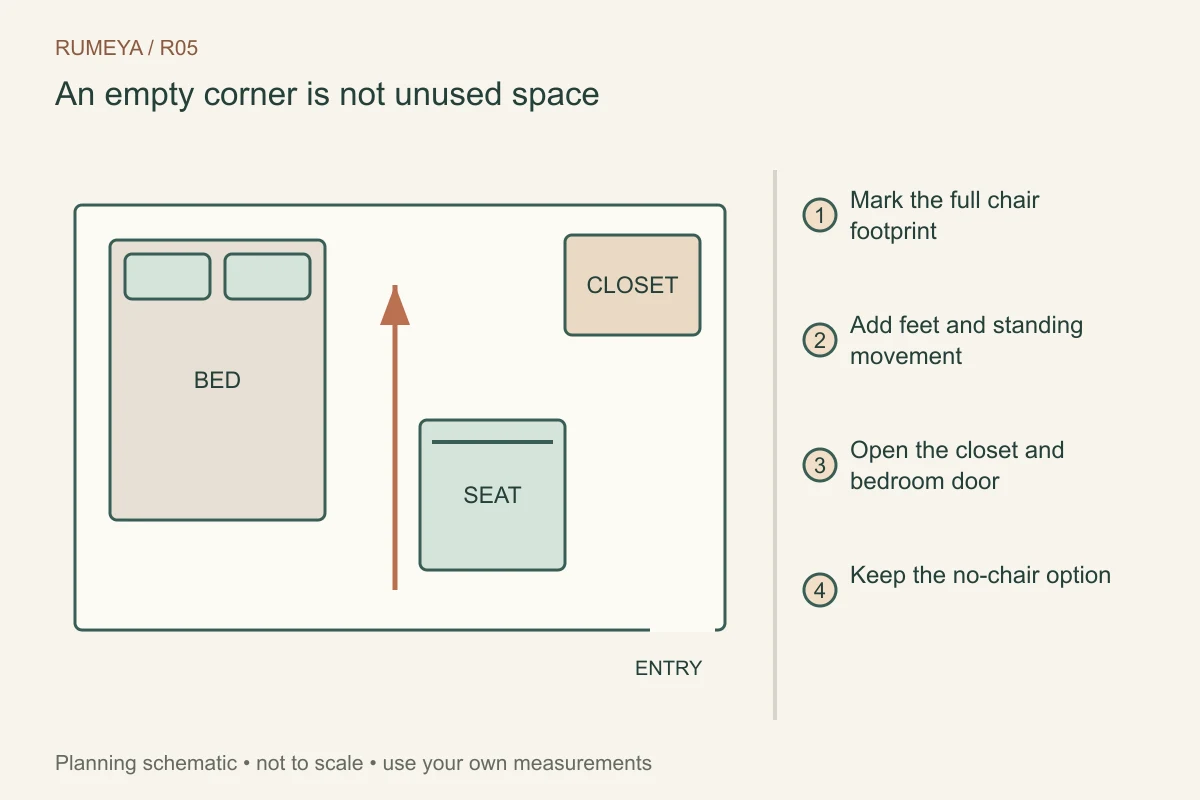
Mark the chair’s widest and deepest points, including arms and a tilted back. If it reclines or swivels, include the manufacturer’s required operating space. Add the area your feet occupy while reading and the movement you use to stand.
Our hypothetical corner has a 42-by-48-inch clear rectangle before the closet opens. A chair 30 inches wide and 34 inches deep leaves 12 inches across the width and 14 along the depth. Those leftover figures do not prove usable access; they simply show how quickly a modest chair fills the apparent empty space.
Open the closet with someone in the chair
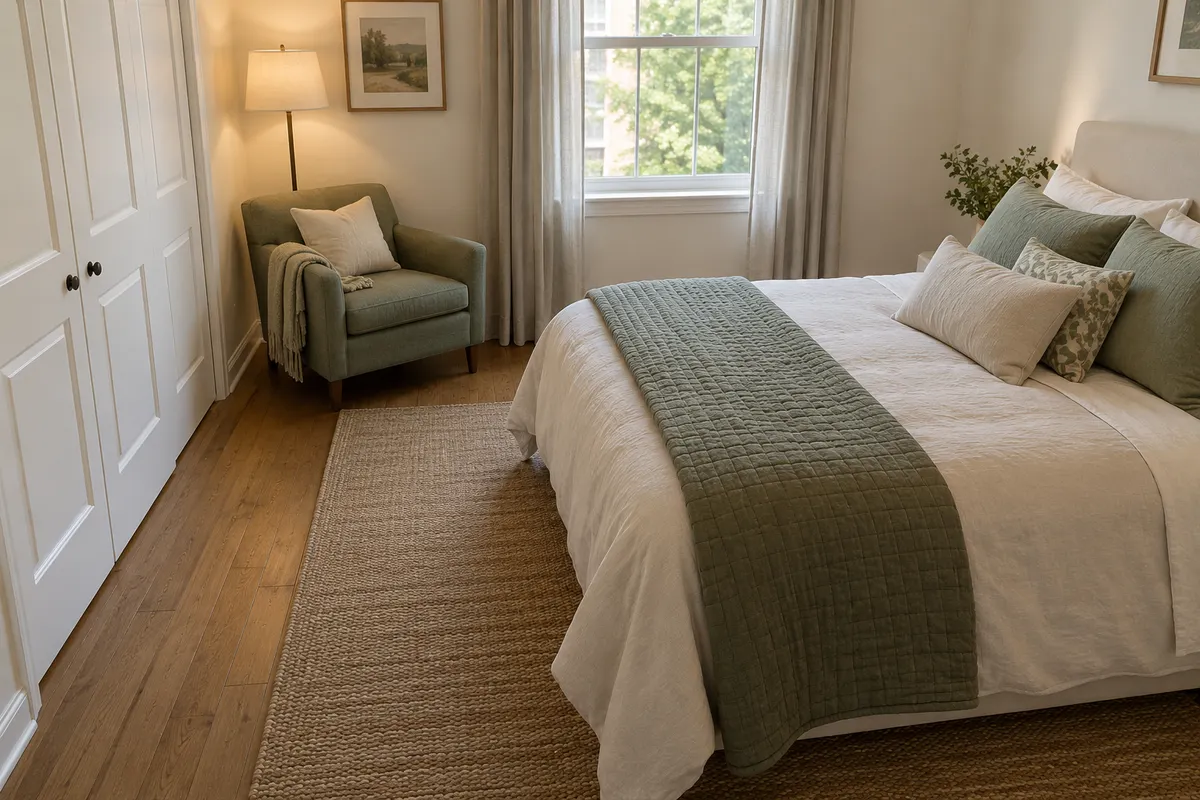
Test hinged or bifold doors through their whole movement. For sliding doors, check the exposed opening and any drawers inside. Someone seated may have feet beyond the chair’s drawn front edge, exactly where a door or storage basket needs to go.
Try the bedroom entrance as well. Walk from the door to each used side of the bed without stepping through the reader’s space. If another person shares the room, have them test the route while you sit normally rather than holding your legs in an unusually tidy position.
Add only the accessories that pass the same test
A lamp needs a stable base and suitable cable route. A side table needs space for its legs as well as its top. Do not add an ottoman until you have tested whether it can remain in place without blocking the closet.
A reachable existing dresser surface may remove the need for another table. Check the actual reach rather than placing a mug where it merely looks close in a photograph. If lighting requires a cable across the entrance, choose another chair position or a different reading location.
Decide from the failed movement
If the closet cannot open, move or remove the chair. If only a separate table causes the conflict, simplify the accessories. If the chair fits but is uncomfortable, do not keep it solely because its dimensions suit the plan.
Our queen-bed layouts can help assess a different bed position, while our reading nook ideas offer alternatives elsewhere. Keep the bedroom corner open when that is what makes the room work.
Compare the options
| Test | Perform with | What failure suggests |
|---|---|---|
| Closet retrieval | Reader seated normally | Move or remove the chair |
| Standing from chair | Lamp and table in place | Reduce accessories or choose another seat |
| Bed access | Another person using the room | Preserve the route before adding a nook |
Before you make a change
- Record the corner’s existing daily uses.
- Mark the chair’s complete outside footprint.
- Test closet access with the chair occupied.
- Accept an open corner if the chair fails.
Sources and planning notes
Room examples and calculations are original planning exercises, not measurements from a home we visited or product tests. Dimensions described as hypothetical should be replaced with your own measurements. The diagram explains the decision; the AI-generated image shows a possible visual example.
See our editorial approach for how we use sources and concept images.