Treat the window as something you use
A window is more than a backdrop for a headboard. You may need to open it, operate a shade, clean the sill, or use it as part of an emergency escape route. Before putting an adult bed beneath it, try the bed against a solid wall and compare what changes.
This article is a room-planning checklist, not a statement that a particular installation meets local building requirements. If you are unsure whether a window serves an emergency escape function, have that checked locally before arranging furniture around it.
Start with who lives in or visits the room
CPSC advises keeping furniture away from windows to reduce children’s climbing and fall risks, and recommends cordless coverings to address cord-strangulation hazards. A bed can become a climbing surface. A layout that looks practical for adults should not be copied into a child’s room or treated as child-safe when children visit.
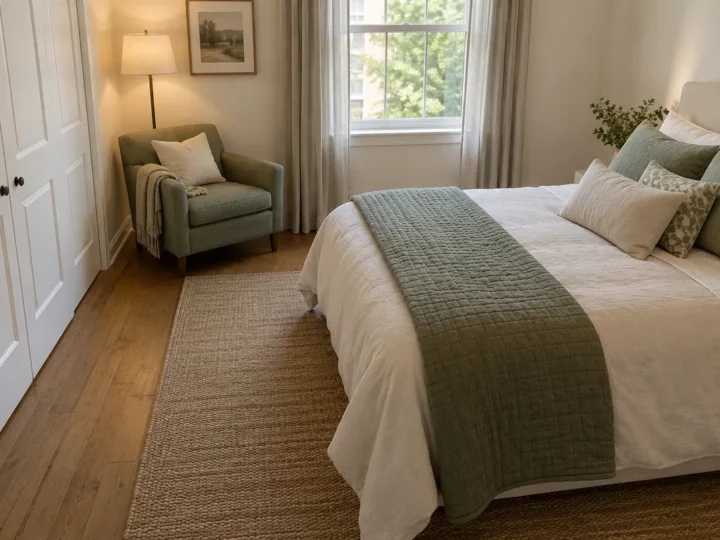
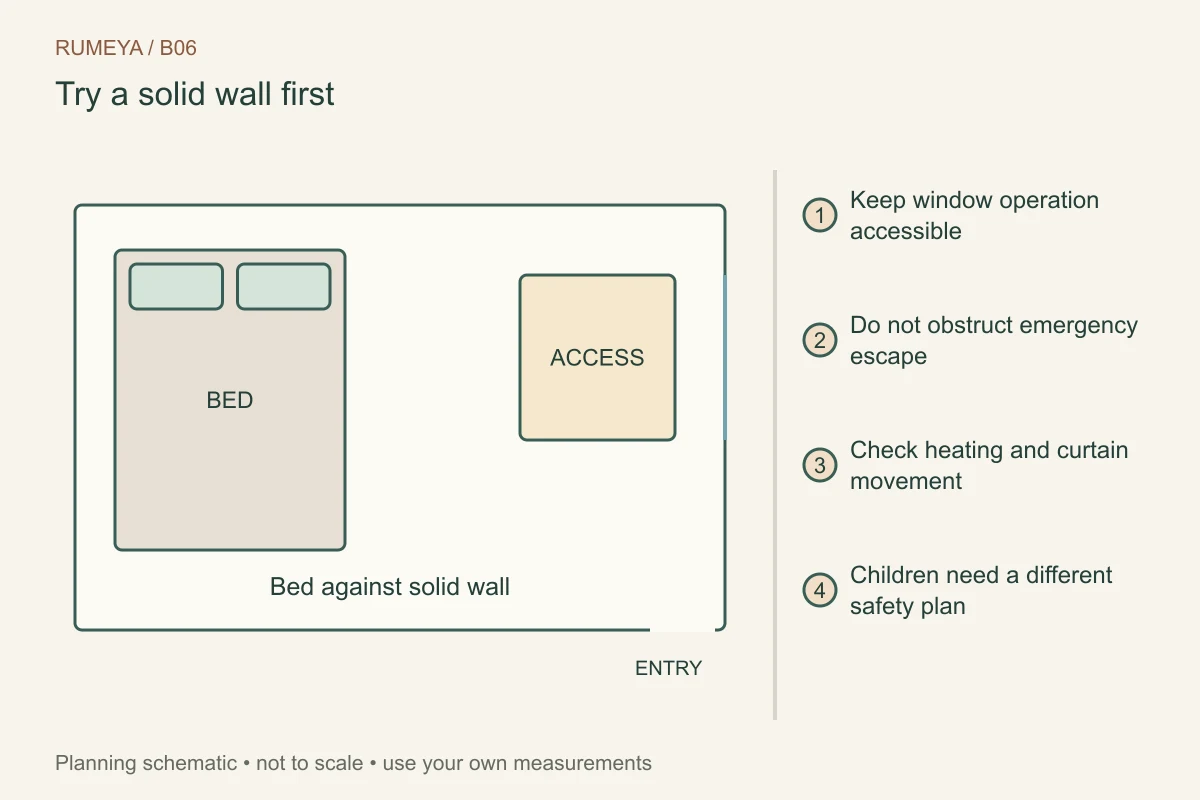
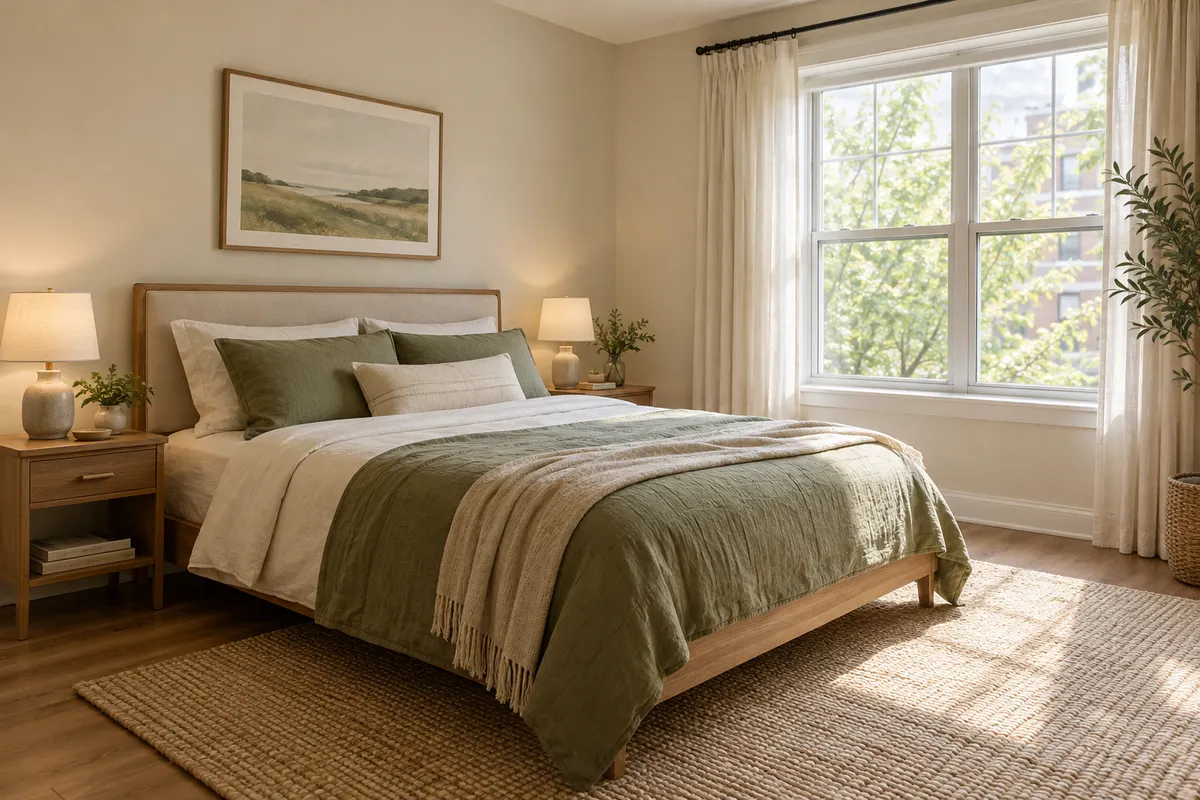
Our illustrated concept therefore shows the alternative: an adult bed on a solid wall with the window area accessible. It is an example of avoiding the conflict, not evidence that a particular distance makes a window arrangement safe.
Check opening, reach, and escape
Operate the window fully with the furniture outline on the floor. Include inward-opening parts, handles, and screens. Can you reach the controls without climbing on the mattress? Can the opening remain unobstructed? A low headboard may clear the glass while the mattress still prevents useful access.
Do not rely on an insect screen as fall protection. CPSC’s window guidance distinguishes screens from protective measures. Any guard or limiting device also needs to be appropriate to the window’s required escape function; get qualified local advice rather than adding a device simply to make a furniture arrangement seem acceptable.
Keep bedding and coverings away from heat
Mark radiators, baseboard heaters, portable heaters, and vents separately. Follow the specific equipment’s clearances and operating instructions. CPSC advises at least 3 feet between portable space heaters and combustible materials such as bedding and curtains. That does not set the clearance for every fixed heating system.
Open and close the curtains in the proposed arrangement. Fabric should not catch behind a headboard, lie on a heater, or require moving the bed every morning. Also check for drafts, moisture, or condensation at the window; furniture placement does not repair a building problem.
Compare the alternative honestly
A solid-wall position may leave less room for a dresser or make the bed off-center. Those are design tradeoffs worth considering before accepting difficult window access. Try a smaller bedside surface or a different storage location first.
Use our three queen-bed layouts to compare centered, offset, and wall-side arrangements. Reject the window-wall option if it compromises operation, required escape, heating safety, or the needs of children in the home. A balanced photograph is not a reason to keep an unsuitable position.
Compare the options
| Question | Check | If it fails |
|---|---|---|
| Can the window work fully? | Opening, handles, and access | Choose another bed wall |
| Is escape kept usable? | Actual local requirements | Obtain assessment before placement |
| Are children present? | Climbing and cord hazards | Use a different safety-led arrangement |
Before you make a change
- Compare a solid-wall position first.
- Check all window movement and access.
- Follow the actual heater instructions.
- Do not use an adult concept as a child-safety plan.
Sources and planning notes
Room examples and calculations are original planning exercises, not measurements from a home we visited or product tests. Dimensions described as hypothetical should be replaced with your own measurements. The diagram explains the decision; the AI-generated image shows a possible visual example.
- CPSC: window falls, furniture, screens, and escape access
- CPSC: window-covering cord safety
- CPSC: portable space-heater precautions
See our editorial approach for how we use sources and concept images.