Open the closet before moving the bed
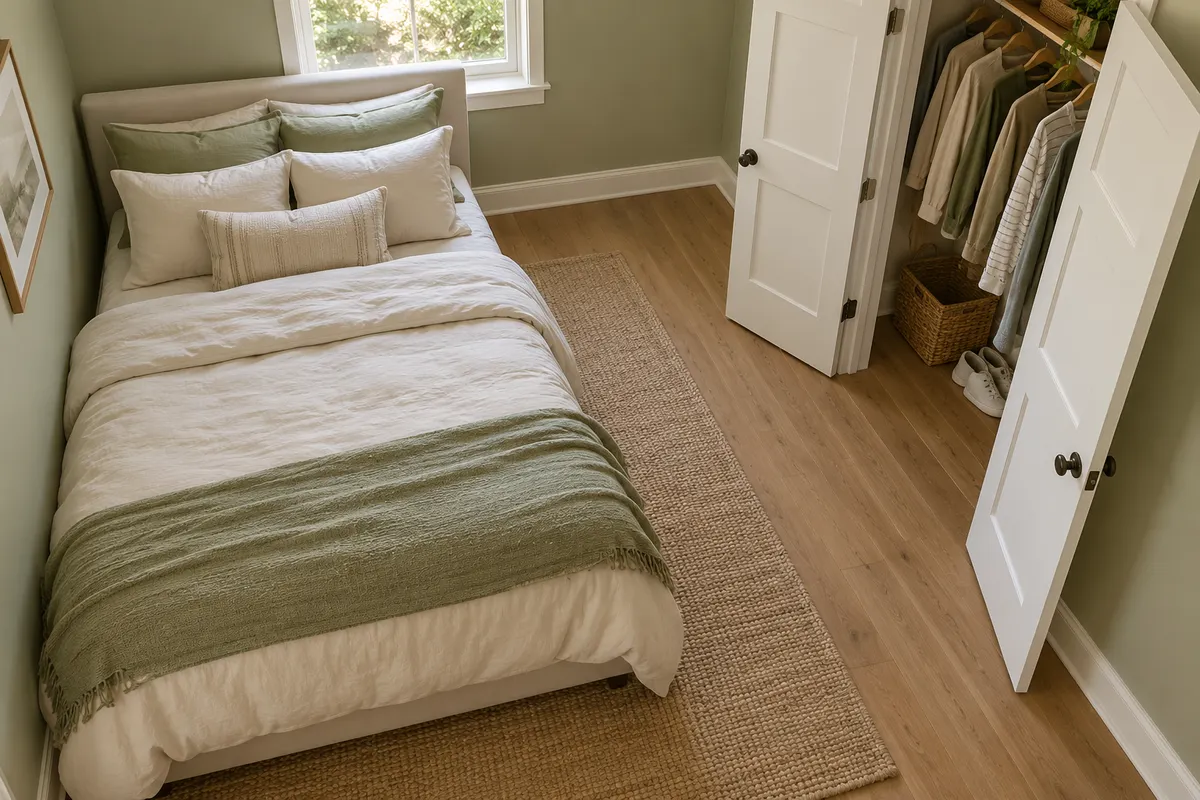
A bedroom can look generous with every door shut and become frustrating as soon as you get dressed. Start with the closet fully open. Stand where you normally reach for clothes, bend toward the lowest shelf, and pull out the drawer or basket you use most.
Mark where your feet and the moving door actually go. That working area is more useful than a neat photograph of the closet front. Keep it visible while arranging the bed, dresser, or reading chair.
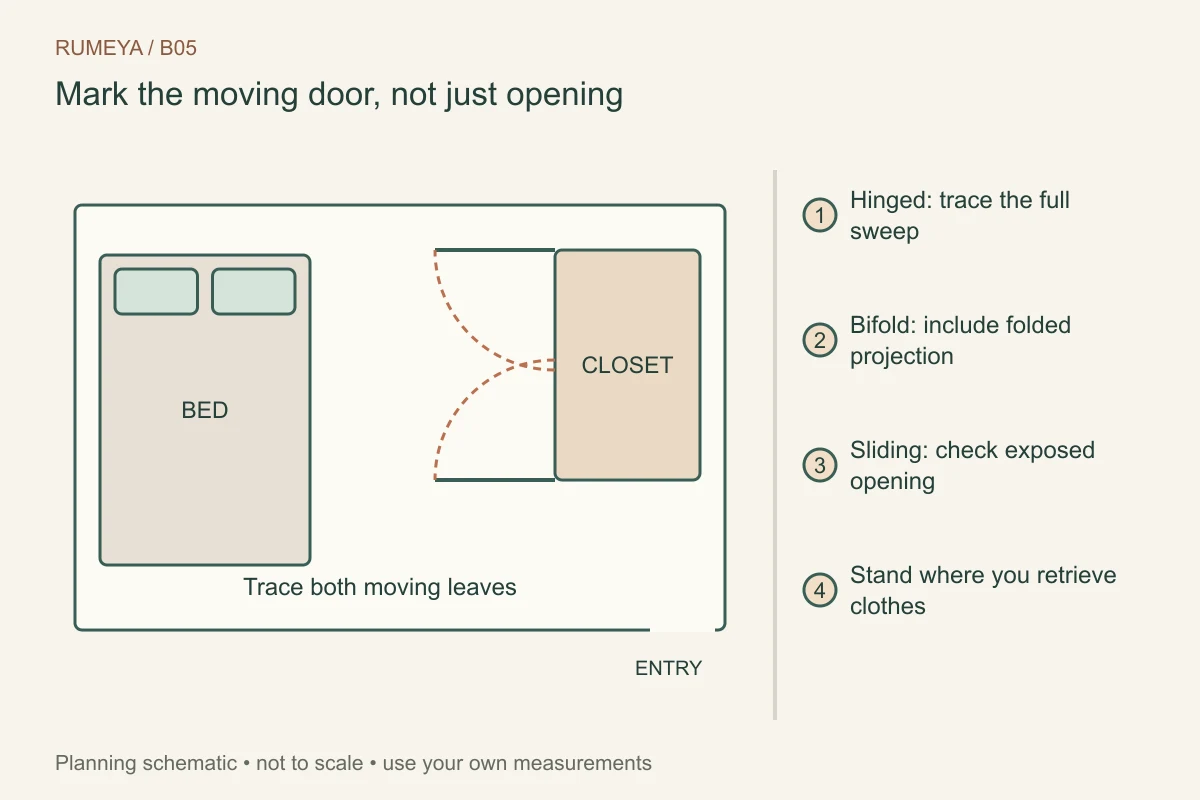
Trace a hinged door through its whole sweep
Measure from the hinge to the farthest projecting edge, including relevant hardware. Mark the door at several points between closed and fully open. A bed corner may miss the final door position but still interrupt the swing halfway through.
Our hypothetical 24-inch closet leaf moves through an arc based on that width. A dresser placed 18 inches from the hinge-side wall could collide depending on its position in the arc. Do not settle this using one subtraction: trace the actual door path and include the handle.
Give bifold doors credit for the space they still use
Bifold panels fold back rather than sweeping like one full-width leaf, but the folded panels and handles remain in front of the opening. They can reduce the clear width available for a drawer, basket, or your shoulders.
Open the doors normally and measure the narrowest usable opening. Pull the largest regularly used object through it. If a storage bin fits the closet interior but catches the folded panel, choosing a shallower bed will not solve that particular problem; the bin or its storage position needs to change.
Test both sides of a sliding closet
Sliding doors reduce outward swing, but one panel generally covers another part of the closet. Move each panel and check which shelves, drawers, and hanging sections become accessible. Do not plan a wide drawer behind an opening that exposes only part of its front.
Try a complete dressing sequence with the bed in its proposed location: open the relevant side, retrieve clothes, reach the lower storage, and close the doors. If another person needs the same route, test that shared moment too. There is no single furniture gap that represents every household’s needs.
Change the furniture before changing the door system
First try moving a bedside table, reducing a dresser’s depth, or shifting the bed without blocking another route. Use our queen bed arrangement guide to compare the consequences for both sleepers.
Replacing closet doors can affect tracks, hardware, wall attachment, and rental permissions. This guide is a furniture-planning test, not instructions for modifying a door system. If a change is necessary, use the exact replacement system’s requirements and suitable installation help. Keep the access area useful after the room is decorated; a basket placed there later can recreate the original problem.
Compare the options
| Door type | Mark on the plan | Try in person |
|---|---|---|
| Hinged | Complete swept arc and handle | Opening past the nearest furniture |
| Bifold | Folded projection and reduced opening | Removing the largest bin |
| Sliding | Exposed width in each position | Opening internal drawers fully |
Before you make a change
- Trace movement, not only the final open position.
- Include handles and folded panels.
- Test retrieval from the lowest storage.
- Keep the working area clear after decorating.
Sources and planning notes
Room examples and calculations are original planning exercises, not measurements from a home we visited or product tests. Dimensions described as hypothetical should be replaced with your own measurements. The diagram explains the decision; the AI-generated image shows a possible visual example.
See our editorial approach for how we use sources and concept images.