Keep a small transition group accessible
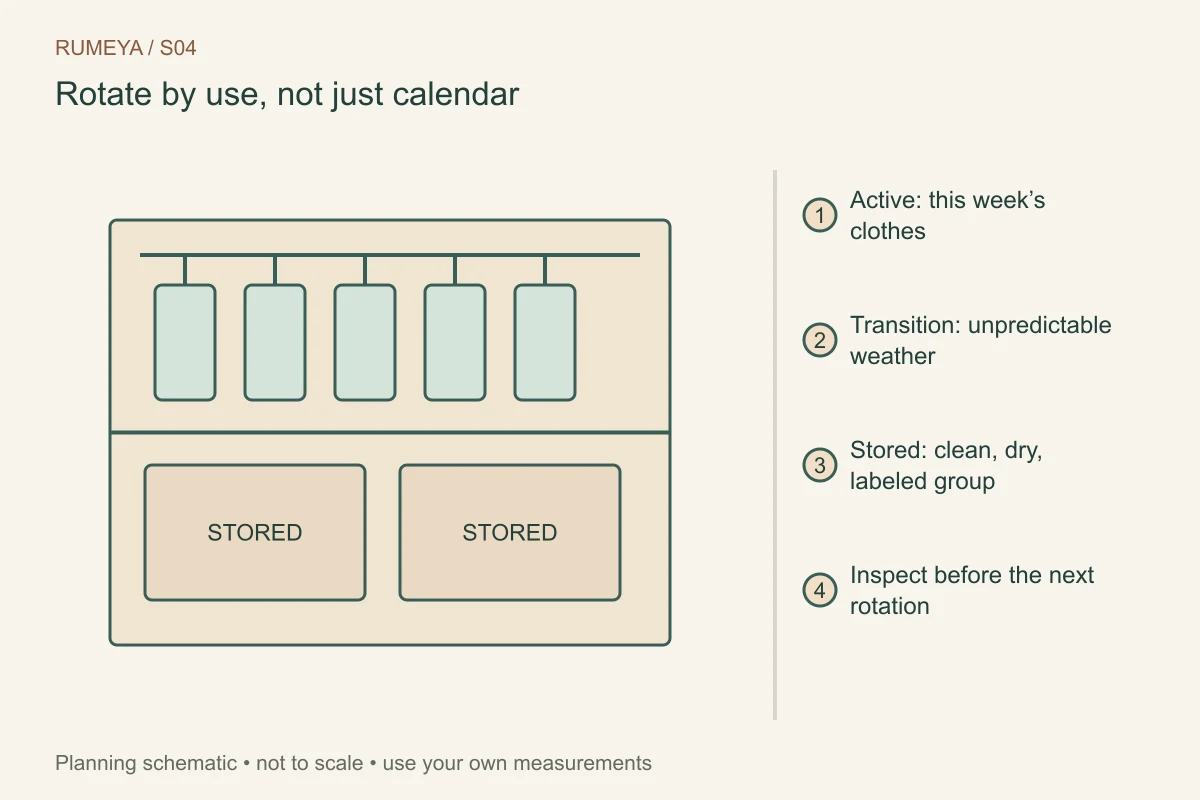
Seasonal storage works poorly when every light layer disappears on the first cold day. Divide the wardrobe into clothes you use now, a small transition group, and items you genuinely will not need for a while. Keep the transition group reachable without opening every storage bag.
Use your weather and routine rather than a rigid date. A work uniform, exercise layer, or travel item may stay active all year. The purpose is to free useful wardrobe space while making the next change manageable.
Sort and care for garments before measuring
Check pockets, fasteners, repairs, and each garment’s care label. Store items only after appropriate cleaning and complete drying. Delicate, structured, or valuable pieces may need specific storage advice; a general apartment organizer is not a substitute for that care guidance.
Smithsonian’s textile guidance concerns preservation rather than ordinary wardrobe styling, but it offers a useful caution about heavy pressure and unsuitable storage conditions. Do not transfer museum methods indiscriminately to washable everyday clothing. Follow the garment maker’s instructions first.

Calculate capacity from a normal fold
Fold one category as you intend to store it and measure the resulting bundle. Our hypothetical group of six sweaters forms two stacks, each 12 by 10 inches and 8 inches high. Side by side, the stacks need a 24-by-10-inch footprint before allowing room to handle them.
A bag advertised as 24 inches long may have less usable interior space because of seams, taper, and the zipper opening. Test a similar box or measure the actual inside. Do not force the zipper shut and treat compression as evidence that the bag is the right size.
Give every group an identifiable home
Use labels that describe contents and size or owner where useful: “winter knitwear” is more informative than “seasonal.” Put the label where it remains visible in storage. Keep a short inventory on your phone if the bags will be out of sight.
Choose a clean, suitable location with access for periodic checks. Avoid assuming a vacuum bag is appropriate for every fabric or garment construction. Compression may be useful for some manufacturer-approved items, but it is not a universal solution for bulky clothing.
Make the next rotation a small job
When the weather changes, bring out one category and inspect it before putting it into daily use. Return only the items leaving rotation. If the stored group grows each season, review whether you still wear it before buying another container.
For bags below the bed, check the frame and removal route using our under-bed storage measurements. Leave the transition group in the main wardrobe so one unexpectedly cool evening does not require a full seasonal unpacking.
Compare the options
| Group | Location priority | Label detail |
|---|---|---|
| Active clothes | Easy daily reach | Usually visible without a label |
| Transition layers | Reachable shelf or drawer | Weather or activity |
| Stored rotation | Suitable clean storage | Category, owner, and contents |
Before you make a change
- Keep transition clothing accessible.
- Follow care labels and dry fully.
- Measure realistic folded bundles.
- Inspect and review at the next rotation.
Sources and planning notes
Room examples and calculations are original planning exercises, not measurements from a home we visited or product tests. Dimensions described as hypothetical should be replaced with your own measurements. The diagram explains the decision; the AI-generated image shows a possible visual example.
See our editorial approach for how we use sources and concept images.