Separate the daily landing from the collection
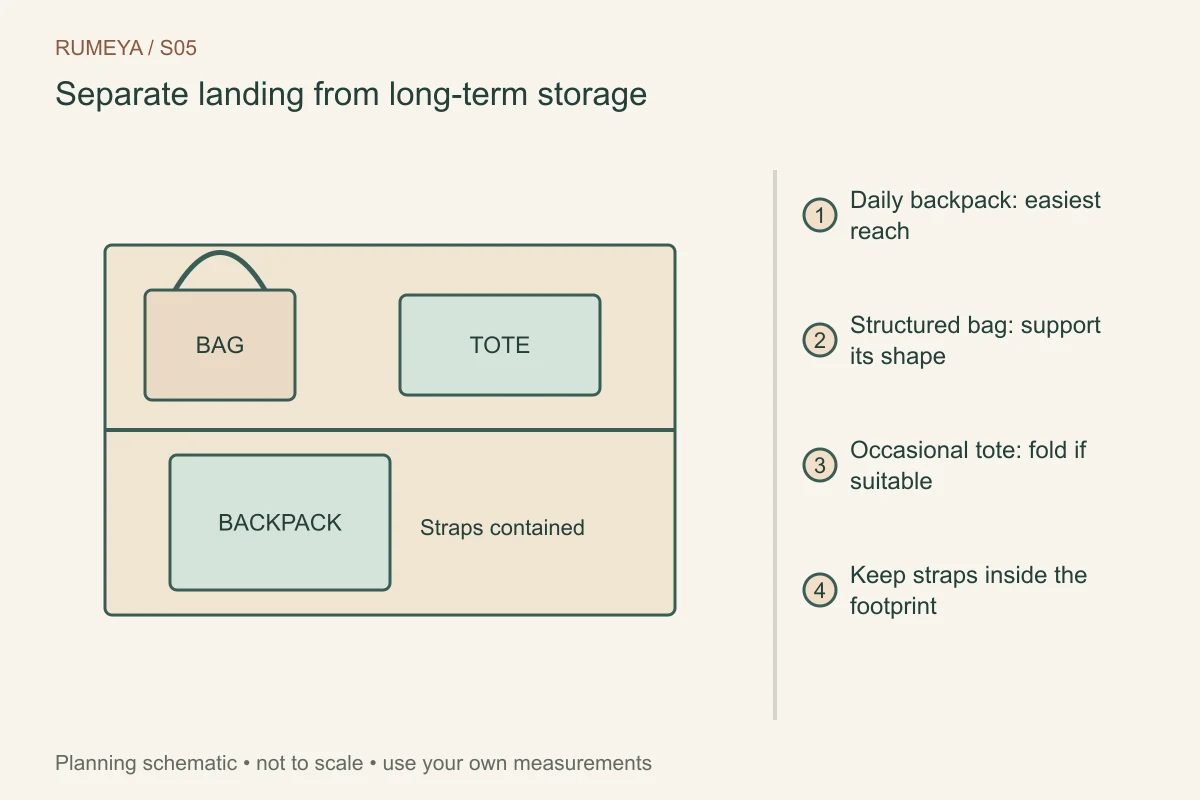
The backpack you bring home each evening needs a quick landing place. An occasional handbag or travel tote needs storage that suits its shape and material. Trying to solve both jobs with one crowded hook often leaves straps on the floor and the daily bag buried.
Choose the everyday bag first and watch where you naturally put it down. A low shelf near that spot may work better than a tidy cabinet across the apartment. Keep the landing area out of the door swing and the route people use with groceries.
Measure bags with their normal contents
An empty backpack can look much slimmer than the one holding a laptop and water bottle. Measure its usual loaded width, depth, and height. Include handles, buckles, and straps that project beyond the body.
For a hypothetical shelf, consider a backpack 13 inches wide, a structured bag 12 inches wide, and a folded tote 8 inches wide. In a single row they use 33 inches before gaps. A 30-inch-clear shelf cannot hold that exact row without overlap or a change of orientation. Check depth and height too, rather than solving only the front view.
Use support where the bag needs it
A structured bag may be better supported on a shelf than hanging by a handle for long periods. Follow its maker’s care and storage advice, including any supplied dust bag or shape support. Do not assume stuffing every bag with paper is suitable for every lining or finish.
A soft tote may fold compactly if its material permits it. A backpack may stand or lie on a shelf, provided it stays contained and does not tip into the route. Keep liquids, food, and damp items from lingering inside storage bags.
Treat hooks as a rated product choice
If you prefer hooks, check the weight of the loaded bag and the exact hook’s rating, installation, and approved surface. A rating applies to the specified setup; it is not permission to hang any bag on an arbitrary adhesive strip.
Door hooks also need clearance above the door and space for the bag when the door opens. Test normal opening and closing without forcing the latch. If the bag knocks into the wall or drags across the floor, a shelf may provide a simpler landing.
Build a quick evening reset
Give the small things inside the bag a consistent destination: keys, receipts, or the charger needed elsewhere. Then return the bag to its own spot with straps contained. The storage should support that routine without requiring you to empty and repack every pocket daily.
Move occasional bags away from the daily landing if they keep crowding it. Our under-bed storage guide can help assess a suitable container for occasional belongings, while the everyday bag stays easy to reach.
Compare the options
| Bag type | Try first | Check |
|---|---|---|
| Daily backpack | Reachable low shelf | Loaded footprint and straps |
| Structured handbag | Supported suitable shelf | Maker’s shape and material care |
| Occasional soft tote | Folded storage if permitted | Find it without unloading daily bags |
Before you make a change
- Measure bags as used, not empty.
- Separate everyday and occasional storage.
- Check hook ratings and approved installation.
- Keep straps out of the walking route.
Sources and planning notes
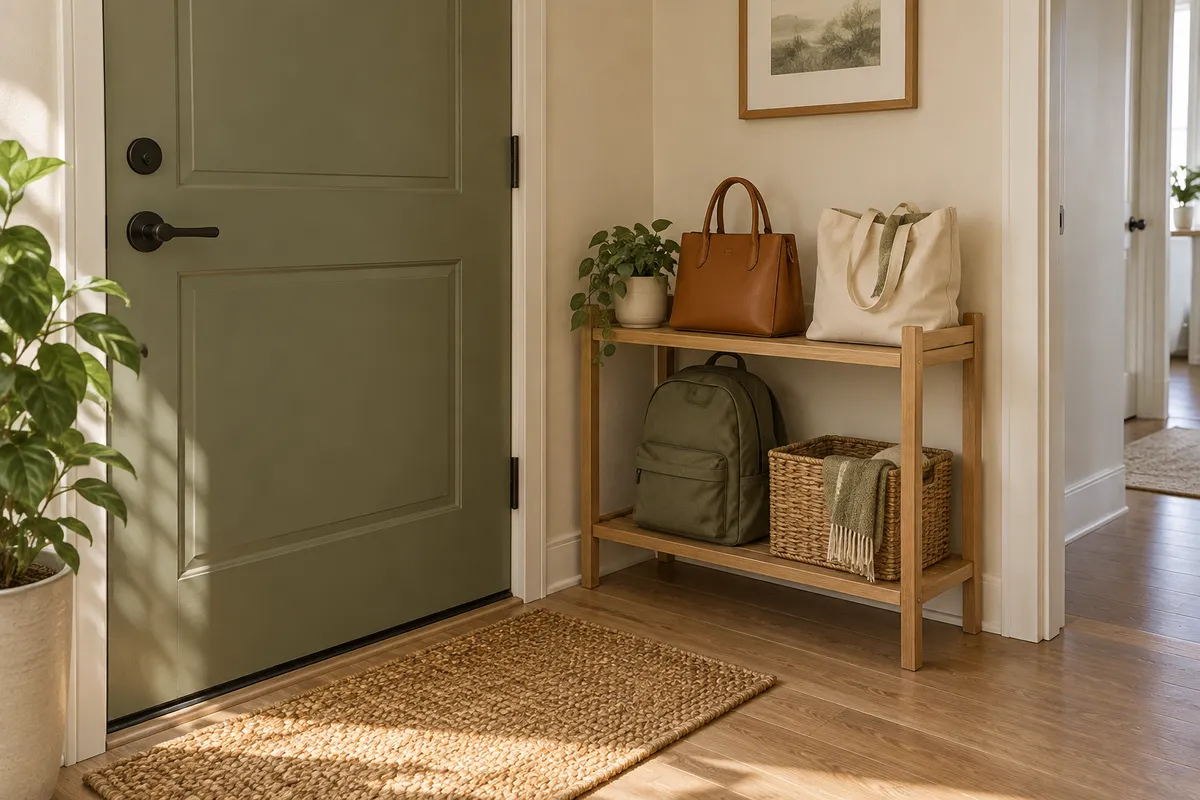
Room examples and calculations are original planning exercises, not measurements from a home we visited or product tests. Dimensions described as hypothetical should be replaced with your own measurements. The diagram explains the decision; the AI-generated image shows a possible visual example.
See our editorial approach for how we use sources and concept images.