Choose a suitable location before the organizer
The most convenient spot beside the stove may expose spices to heat and steam. Start with a location that suits the product’s storage directions, then choose an organizer for that space. Do not let a matching jar set decide where the spices live.
McCormick advises keeping spices tightly capped and away from heat, moisture, and direct sunlight. Check individual product directions as well. This guide compares storage layouts; it does not establish shelf life or tell you whether an old spice is suitable to use.
Inventory the jars you actually reach for
Gather the everyday spices and separate occasional ingredients from duplicates. Record the tallest jar and widest base, including grinders and tins that do not match standard bottles. Keep product identity, ingredients, relevant dates, and storage directions available if you transfer anything.
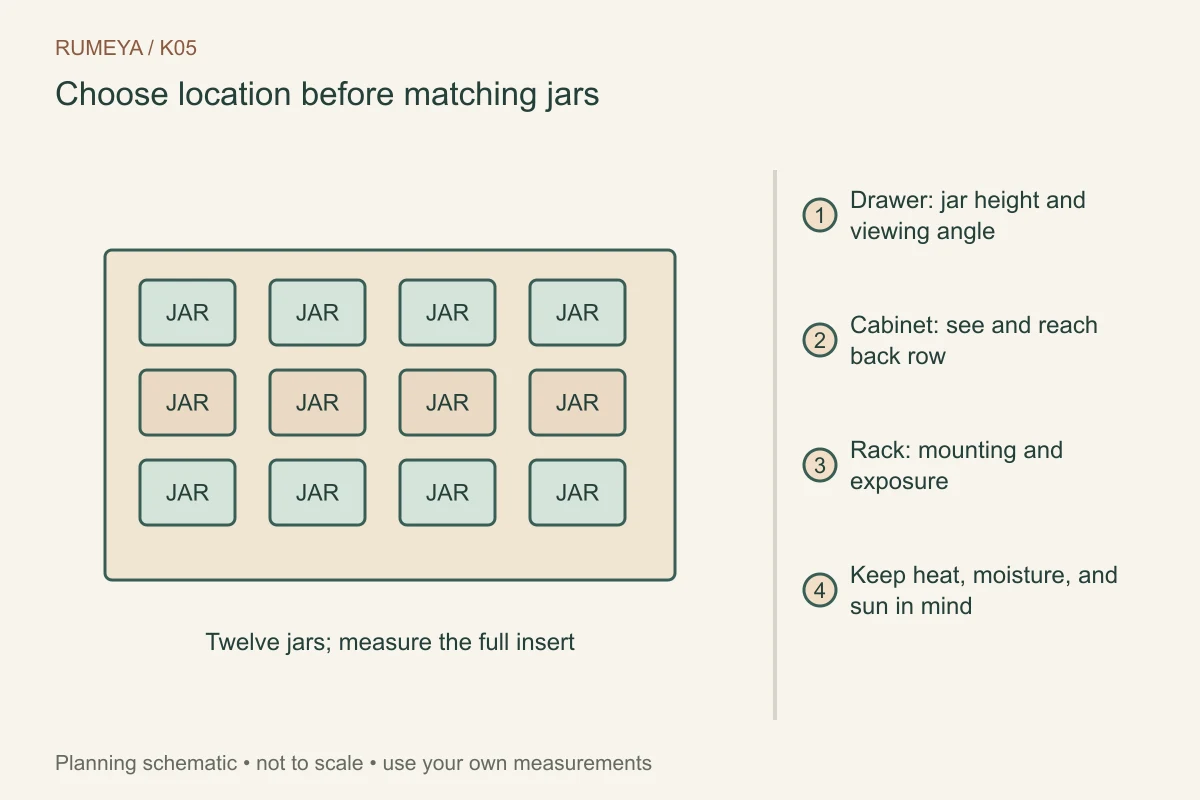
Our hypothetical set has twelve jars, each 2 inches in diameter and 4 inches tall. A four-by-three upright grid occupies 8 by 6 inches before gaps or dividers. That does not mean a drawer only 4 inches high will close over the jars; measure the actual clear height and lids.
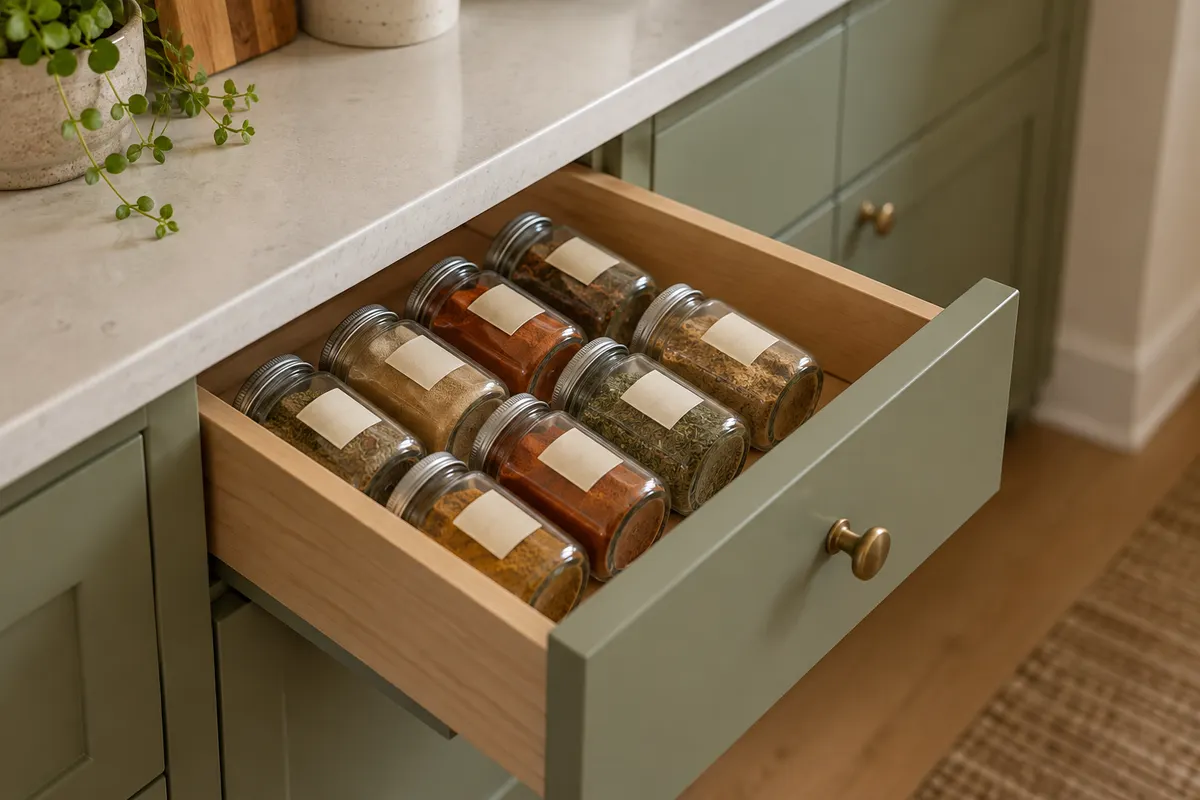
Use a drawer when the labels remain readable
A drawer can present jars from above. Upright bottles may need readable top labels, while angled inserts can expose front labels at the cost of depth. Measure the complete insert with the jars loaded, not just the empty frame.
Try opening the drawer, finding one jar, and returning it without disturbing the row. Keep the drawer away from unsuitable heat or moisture exposure. A convenient label arrangement is not a reason to ignore the storage conditions.
Use a cabinet when the back row stays accessible
A cabinet can accommodate mixed jar sizes, but deep rows hide duplicates. A suitable shallow bin or riser may improve access. Check the clear opening, hinge position, and height above the raised row.
A removable bin needs somewhere to land and a manageable loaded weight. A riser needs enough space for your hand to remove the rear jar. Avoid building an impressive display that requires unloading the front every time you cook.
Choose a rack only after checking its installation
A rack may use a narrow wall or cabinet-door area, but its load rating, approved fixings, and closed-door clearance matter. Keep it away from the exposure the spice maker warns against. Test the tallest jar with nearby shelves before mounting anything.
Our small kitchen coffee station guide can help separate brewing supplies from cooking ingredients when both compete for the same drawer. Choose one primary spice location and check it before shopping so duplicates do not quietly fill the new system.
Compare the options
| Location | Useful quality | Main tradeoff |
|---|---|---|
| Drawer | Easy overview from above | Jar height and insert depth |
| Cabinet | Fits mixed packaging | Back-row access |
| Suitable rack | Uses a defined vertical area | Exposure, load, and mounting compatibility |
Before you make a change
- Follow product storage directions.
- Measure nonstandard jars and grinders.
- Test the loaded organizer and hand access.
- Keep one primary location for the everyday set.
Sources and planning notes
Room examples and calculations are original planning exercises, not measurements from a home we visited or product tests. Dimensions described as hypothetical should be replaced with your own measurements. The diagram explains the decision; the AI-generated image shows a possible visual example.
See our editorial approach for how we use sources and concept images.