Match every lid before choosing dividers
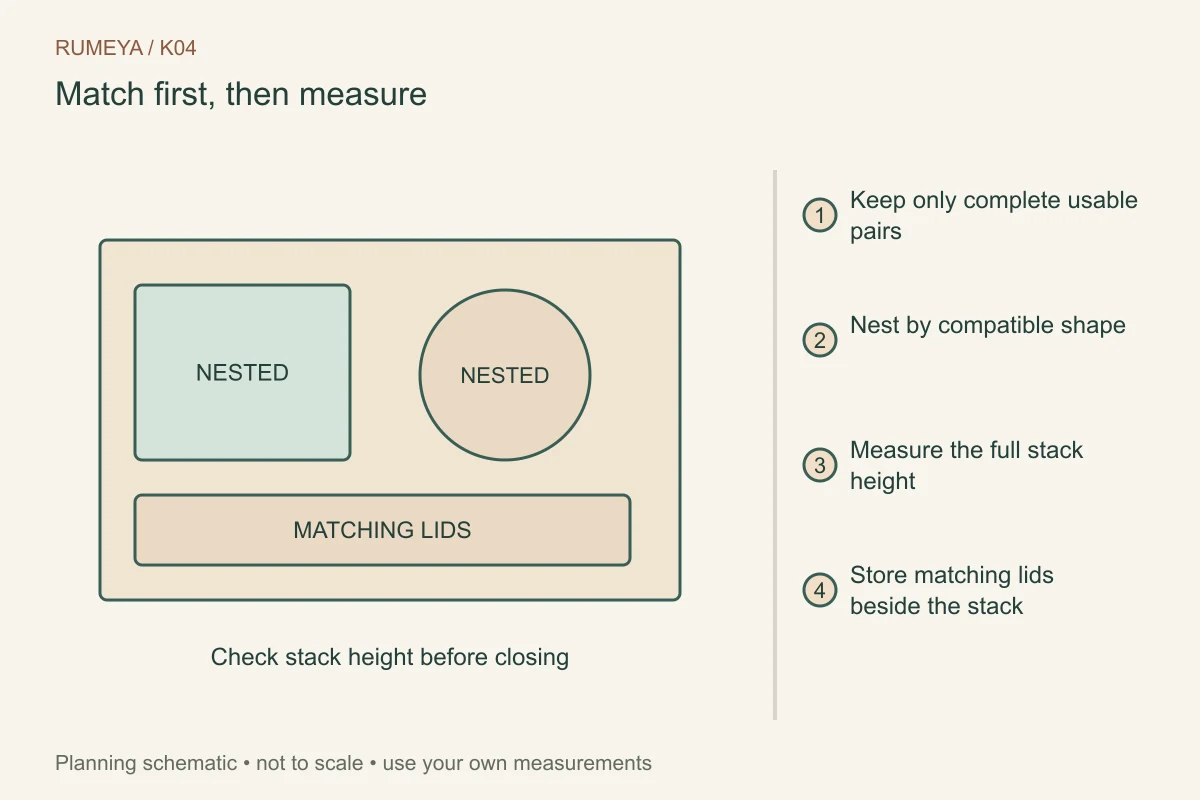
Spread the empty containers and lids on a clear surface and match them. Similar-looking lids may belong to different sets, so test the actual fit. Review damaged or incomplete pieces according to the manufacturer’s guidance rather than keeping them in the everyday drawer by default.
Choose the containers you use for a normal week: packed lunches, leftovers, or another specific routine. This article organizes empty storage pieces; it does not set food-safety temperatures, storage times, or microwave suitability. Follow the markings and instructions for each container.
Measure the drawer where it closes
Record the clear interior width and depth, then measure usable height beneath any rails or cabinet structure. A drawer can be deep at its front while a taller stack catches farther back. Include the divider’s thickness in the plan.
For an invented example, a drawer with an 18-by-16-inch usable base and 6 inches of clear height holds a 9-by-7-inch nested stack only if that stack, including any protruding handles, stays below the closing obstruction. Do not calculate capacity from the empty drawer’s outside dimensions.
Group containers by nesting behavior
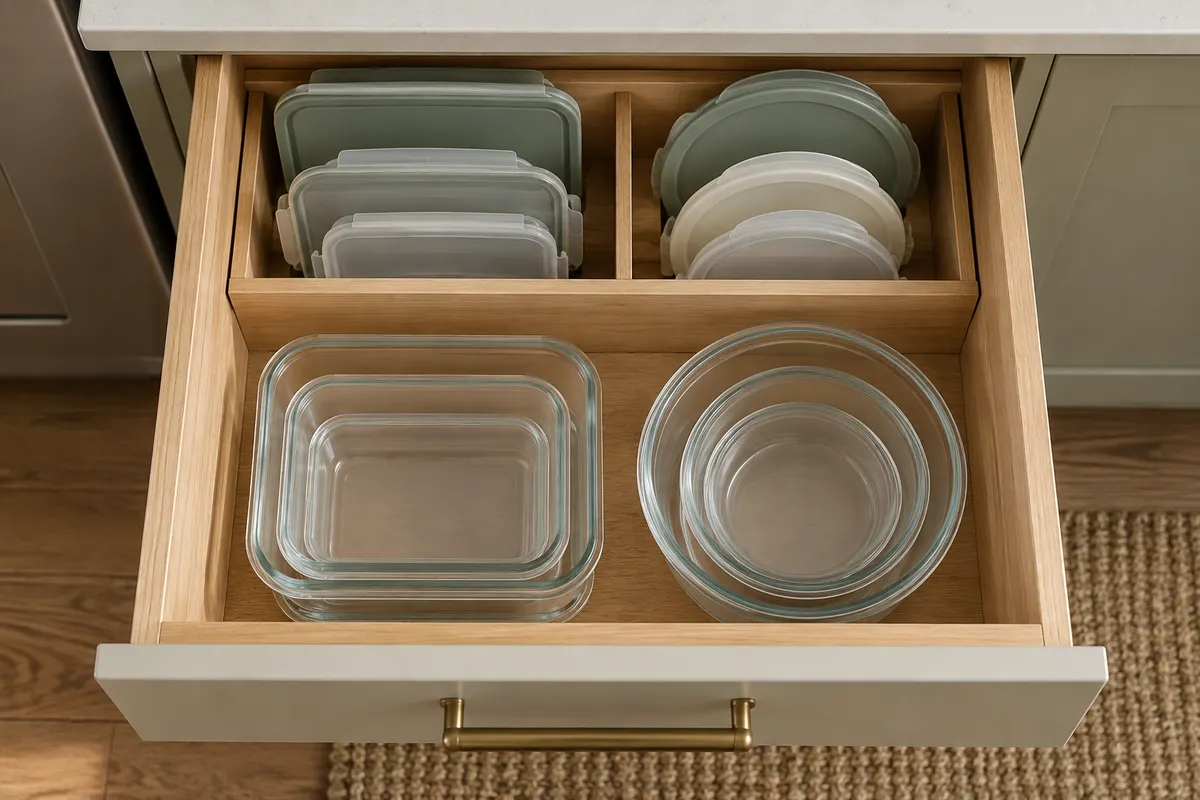
Put compatible rectangular pieces together and round pieces together. Test whether each stack lifts apart easily. A tightly jammed stack may use little space but make daily retrieval frustrating.
Keep a frequently used size near the front instead of burying it beneath occasional pieces. If two containers share a nominal volume but have different shapes, treat them as separate footprints. A smaller, consistent active set may organize more easily than a large mixed collection with several nearly matching lids.
Stand lids where you can identify them
Use a suitable divider to keep lids upright if the drawer height allows it, or make a short flat stack beside the corresponding containers. Measure the tallest lid in the chosen orientation. Keep labels or manufacturer markings visible where useful.
Check that the divider stays in place during normal opening and closing. Avoid over-tightening adjustable organizers against a drawer not designed for that pressure. Leave enough room to remove one lid without pulling the entire group out.
Test the drawer after a busy day
Put away the clean, fully dry pieces after normal use and then assemble tomorrow’s lunch container. Can you find the right pair without moving unrelated items? If not, change the grouping rather than adding another divider immediately.
Keep overflow intentional. An occasional oversized container can live in a different suitable cabinet rather than distorting the whole drawer layout. Our coffee station guide shows another way to reserve a small drawer for one routine; apply the same clear boundary here.
Compare the options
| Group | Suggested arrangement | Deciding measurement |
|---|---|---|
| Rectangular containers | Compatible nested stack | Largest base and total stack height |
| Round containers | Separate nested stack | Diameter and easy separation |
| Matching lids | Upright divider or short stack | Height, thickness, and hand access |
Before you make a change
- Match lids to their actual containers.
- Measure usable drawer height through its travel.
- Keep frequent sizes near the front.
- Test the system while putting dishes away.
Sources and planning notes
Room examples and calculations are original planning exercises, not measurements from a home we visited or product tests. Dimensions described as hypothetical should be replaced with your own measurements. The diagram explains the decision; the AI-generated image shows a possible visual example.
See our editorial approach for how we use sources and concept images.